AI Infrastructure · Systems Engineering

I build the infrastructure around AI that has to hold when reality gets messy.

LLM systems, agent security, behavioral release assurance, inference-change decisions, and governed automation — designed around failure states, not just successful demos.

In production at Setareh Hamoon, I cut inference p95 latency from 850 ms to under 200 ms — vLLM batching, Redis semantic caching, and Celery/Kafka pipelines, measured on the serving stack, not a demo.

Ten systems, five control boundaries.

Every system in the record, with the boundary it owns and the source status it actually has. The ordering below is the register, not a ranking.

01

Runtime security

authorization · execution integrity

02

Release assurance

behavioral change · regression gates

03

Inference systems

quality · reliability · latency · cost

04

Applied AI ops

durable workflows · controlled effects

01—03

Three distinct failure boundaries

Three places AI can lose control.

What was allowed to execute. What changed before release. What evidence is sufficient to accept an inference change.

Execution integrity

AgentGuard

The action that executes should still be the action that was authorized.

Deterministic runtime authorization for actions routed through AgentGuard, binding authorized intent to bounded credentials, guarded dispatch, and reconciliation of uncertain effects. The linked reference, package 0.1.0, is a separate minimal example and not a newer Core release.

AUTHORIZED INTENT / LIVE ACTION

DRIFT → REFUSE
01intentrefund.create · ≤ $100BOUND
02credentialintent fingerprintBOUND
03live callrefund.create · $150CHANGED
04dispatchside effectREFUSED
02Release assurance

ProofDiff

A change should trigger the evidence its blast radius actually requires.

Evidence-first release assurance that identifies what changed, selects the protected behaviors implicated by that change, replays the required evidence, and returns a scoped PASS / REVIEW / BLOCK decision.

Public proof point

tool:refund.create → 4 / 9 → fixed → PASS

01

CHANGE

tool:refund.create

02

SELECT

4 / 9 contracts

03

REPLAY

fixed

04

DECIDE

PASS

Unknown impact widens the evaluation surface. It never earns a cheaper test plan.

fail closed
03Inference decision

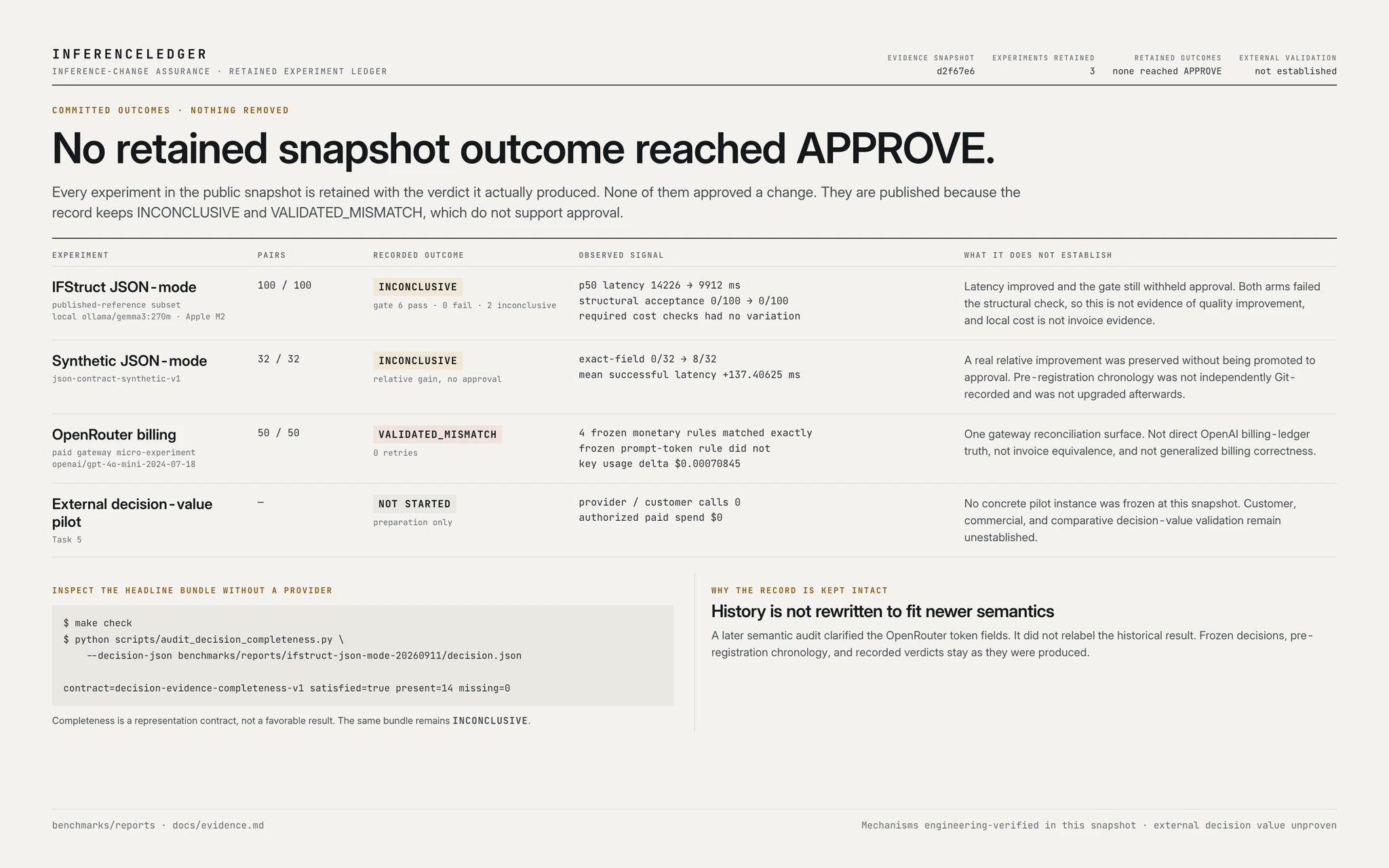
InferenceLedger

A cheaper model is not a better migration if a required floor breaks.

Evidence-driven inference-change assurance for one model, provider, or execution-policy change, judged against requirements declared before the comparison.

InferenceLedger retained evidence board. Two outcomes are INCONCLUSIVE, one is VALIDATED_MISMATCH, the external pilot is not started, and no retained snapshot outcome reached APPROVE.
Retained evidence boardNo snapshot reached APPROVE
04 · Applied systemoperating workflow

Content Automation Pipeline

A full-stack AI content operations platform spanning research, retrieval, generation, editorial review, revision-bound publishing, Search Console feedback, and controlled release operations.

Research, generation, review, exact-revision approval, publishing, feedback, and release operations share one explicit state model instead of leaking authority between steps.

01RESEARCHsource-bound
02REVISIONimmutable
03APPROVALexact-revision
04PUBLISHcontrolled

Research state

UNRESOLVED

is a valid state

Claims do not become stronger because the portfolio wants a cleaner ending.

External validation, inconclusive outcomes, and missing evidence stay visible instead of being converted into marketing certainty.

Validation register
Work / research / collaborationcontact

If the system needs to stay explainable when evidence is incomplete, authority changes, or reality becomes ambiguous, that is the kind of engineering problem I want to work on.

mohammadaliatashi@icloud.com